

Best overall: choose the ticket with enough included baggage for your complete journey, not the airline with the largest headline allowance. Best for onward Indian connections: Air India; best for piece-based packing: British Airways; best for weight-based packing via Dubai: Emirates; best for comparing a Doha connection: Qatar Airways.
- For the best airlines by baggage allowance UK India flights, compare the exact fare and every operating carrier.
- Air India is the first comparison for journeys combining an international flight with an Indian domestic connection.
- British Airways suits piece-based packing; Emirates suits a weight-based comparison on UK–India itineraries.
- Mann Travel Uk readers should compare checked baggage, cabin baggage and connection rules before choosing a ticket.
Why this matters
The best baggage deal in 2026 is an allowance you can actually use throughout your journey. A generous international allowance does not settle what happens on a separately booked domestic flight, and an airline name does not tell you which fare conditions apply.
Start your Mann Travel Uk comparison with your destination, travel dates and packed luggage requirements. Then compare tickets against the same checklist. For Mann Travel Uk readers, the best airlines by baggage allowance are those whose ticket conditions match the bags they will carry.
This shortlist separates four useful booking situations. It is a decision guide, not a claim that one airline includes more checked baggage on every UK–India route.
What makes the best airline for baggage?
Use these criteria before looking at the airline ranking:
- Included checked baggage: Compare the allowance attached to the exact fare, not a general economy-class description.
- Weight or pieces: Establish whether the ticket specifies total weight, a number of bags, or both.
- Individual bag limits: Check each suitcase against the airline’s weight and size restrictions, even when your combined weight fits.
- Cabin baggage: Include your cabin suitcase, personal item and any separate restrictions on their weight or dimensions.
- Connecting flights: Identify the operating carrier on every sector and establish which baggage rules apply to the itinerary.
- Return journey: Read the outbound and inbound allowances separately, particularly when the carriers or fares differ.
A ticket passes only when it covers your actual packing plan. An unused allowance is not a benefit, and extra weight in the hold does not solve an overweight cabin bag.
Best airlines at a glance
| Airline | Best for | Standout consideration | Key limitation |
|---|---|---|---|
| Air India | Onward Indian connections | Compare the international and domestic journey together | A separate domestic booking needs its own baggage check |
| British Airways | Piece-based packing | Economy checked bags have a published individual weight limit | Some economy fares do not include checked baggage |
| Emirates | Weight-based packing via Dubai | UK–India journeys use weight-based checked baggage rules | The fare determines the included weight |
| Qatar Airways | Comparing a Doha connection | Weight-based checked baggage on UK–India journeys | Cabin baggage needs a separate weight check |
The table does not rank headline kilograms. In 2026, your booking decision should rest on the baggage entitlement displayed for the ticket you are about to purchase.
1. Air India: best for onward Indian connections
Air India operates international and domestic flights, making it a useful first comparison when your destination is beyond your Indian arrival airport. Look at the complete itinerary rather than choosing the international leg first and solving the domestic connection afterwards.
The baggage question is whether your allowance applies across the booked journey. Do not assume that buying flights under the same airline name makes separate tickets equivalent to a through-booking.
Air India pros:
- A relevant starting point for comparing international travel with onward Indian domestic flights.
- Lets you assess an Air India-operated itinerary as a complete journey.
- Keeps the baggage discussion focused on your final destination rather than only the arrival gateway.
Air India cons:
- A separate domestic ticket requires a separate allowance check.
- The airline name alone does not establish your checked baggage entitlement.
- An itinerary involving another operating carrier needs additional scrutiny.
Best for: Travellers continuing beyond their international arrival airport in India.
Before booking in 2026, ask for the baggage entitlement on every sector and confirmation of any baggage collection and recheck requirement. Through-checking baggage and receiving the same allowance are different questions; establish both.
Verdict: Buy an Air India itinerary when the complete journey meets your baggage requirements; hold if the domestic sector remains unresolved.
2. British Airways: best for piece-based packing
British Airways is useful for travellers who prefer planning around individual suitcases. Its published economy checked-bag weight limit is 23 kg per bag, but the number of included bags depends on the ticket; some economy fares include no checked bag.
That distinction matters. A bag’s permitted weight tells you nothing about whether that bag is included in your chosen fare.
British Airways pros:
- Piece-based rules make suitcase-by-suitcase planning straightforward.
- The published economy per-bag limit gives you a clear packing checkpoint.
- A relevant comparison when a suitable British Airways-operated UK–India service matches your journey.
British Airways cons:
- A cabin-only fare does not meet a checked-baggage requirement without an addition.
- Unused capacity in one suitcase does not automatically permit another suitcase to exceed its limit.
- A connecting flight operated by another airline needs its own baggage-rule check.
Best for: Travellers who want to organise packing by the number and weight of individual checked bags.
Check the included bag count before comparing British Airways with a weight-based allowance. Then check dimensions: a suitcase can satisfy the weight rule and still breach the size rule.
Verdict: Buy British Airways when the included pieces fit your packing plan; skip a cabin-only fare if you require included checked luggage.
3. Emirates: best for weight-based packing via Dubai
Emirates uses a weight concept for checked baggage on UK–India journeys via Dubai. Your fare determines the included weight, so compare the exact fare rather than treating every economy ticket as equivalent.
Emirates publishes an economy cabin-baggage weight allowance of 7 kg. Check its current cabin-bag dimensions and permitted items alongside that figure; a checked allowance does not expand the cabin allowance.
Emirates pros:
- Weight-based checked baggage suits travellers who plan around total luggage weight.
- Provides a clear alternative to a piece-based comparison.
- A relevant choice when a Dubai connection suits your itinerary.
Emirates cons:
- The economy fare determines the checked weight included.
- Each checked bag must still satisfy individual handling and size restrictions.
- A Dubai connection adds a transfer to the journey.
Best for: Travellers comfortable connecting in Dubai who prefer comparing checked baggage by total weight.
For a 2026 booking, assess both directions before deciding. If your return packing differs from your outbound packing, the return entitlement deserves its own check rather than a quick glance at the first flight.
Verdict: Buy Emirates when the fare’s checked weight and cabin rules fit your luggage; hold if you have only checked the headline allowance.
4. Qatar Airways: best for comparing a Doha connection
Qatar Airways uses weight-based checked baggage on UK–India journeys via Doha. It belongs in your comparison when the route and connection work for you, but its inclusion here is not a claim that it always offers more baggage than Emirates or Air India.
Qatar Airways publishes an economy cabin-baggage weight allowance of 7 kg. Keep that cabin check separate from the checked-baggage comparison, particularly if you carry a laptop, medicines or other items you need during the journey.
Qatar Airways pros:
- Offers a weight-based checked-baggage alternative for a Doha itinerary.
- Lets you compare another connecting journey against your preferred packing plan.
- Makes total checked weight a central comparison point rather than bag count alone.
Qatar Airways cons:
- The included checked weight depends on the fare.
- A Doha transfer is part of the journey.
- A satisfactory checked allowance does not remove cabin-baggage restrictions.
Best for: Travellers comparing a Doha connection against other UK–India itineraries.
Read any partner-operated sector carefully. The airline selling the ticket and the airline operating a flight are not always the same, and your itinerary must explain the applicable baggage conditions.
Verdict: Buy Qatar Airways when the complete itinerary meets your requirements; hold if a partner sector’s baggage conditions are unclear.
Turn your packing plan into a booking decision
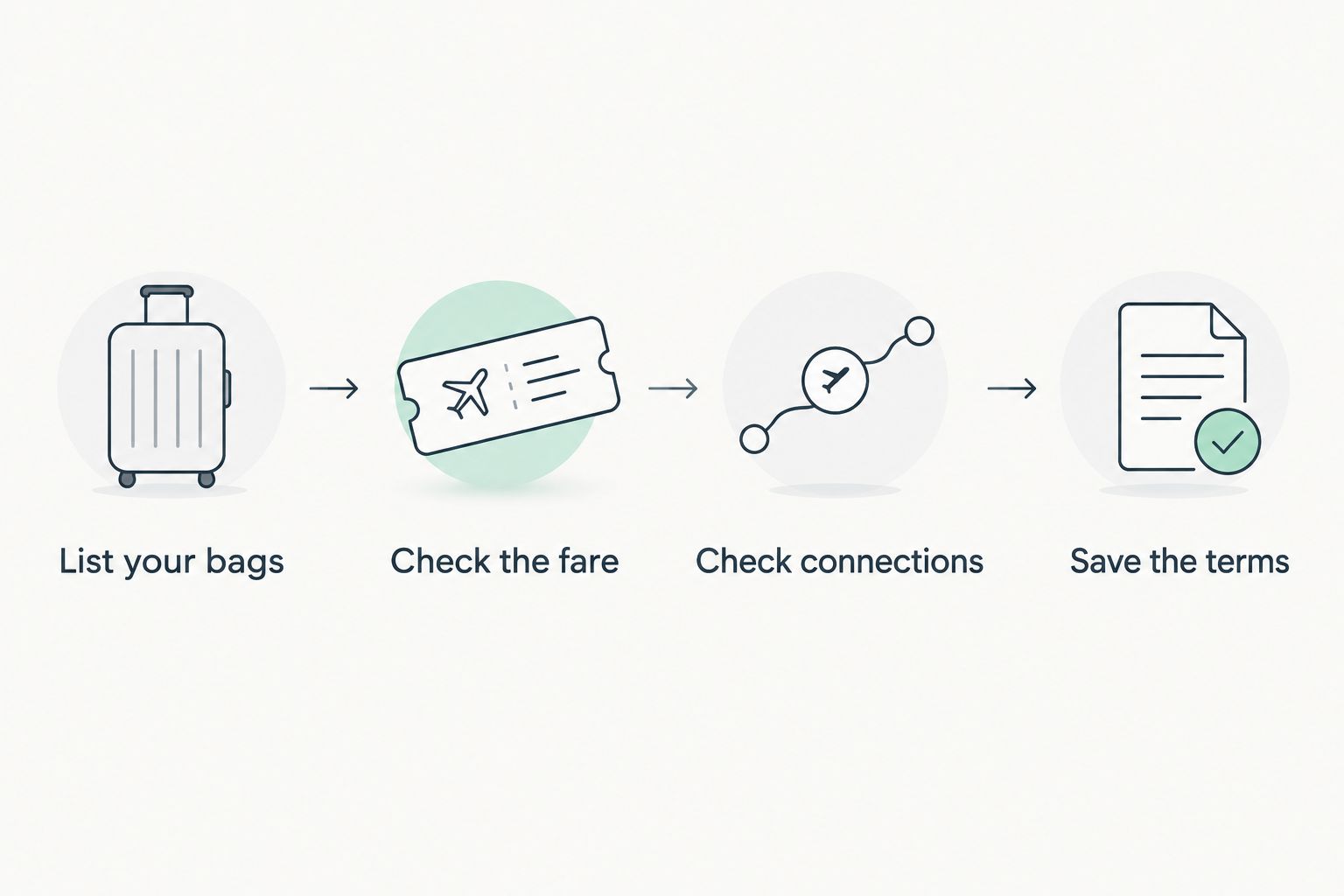
Use this sequence before choosing among the shortlisted airlines. It keeps the comparison attached to your needs rather than to an attractive allowance you have not checked.
- List your bags. Separate checked suitcases, cabin baggage and any unusual items. Include both directions of travel.
- Check the fare. Read the allowance for the exact ticket, including the number of pieces or total weight and individual bag restrictions.
- Check connections. Confirm the operating carriers, ticket arrangement, baggage collection requirements and onward allowance.
- Save the terms. Keep the baggage details supplied with your booking so you can refer to the entitlement you purchased.
Do not leave the connection check until after payment. An international ticket and a domestic ticket can each look suitable in isolation while failing to accommodate the same luggage throughout the journey.
A useful booking question is specific: ask whether your planned checked bags and cabin bag meet the allowance on every flight. Asking only how much baggage an airline allows leaves the fare, route and connection unresolved.
Start your flight comparison
Compare your UK–India itinerary with your checked baggage, cabin bag and onward connection requirements.
How the airlines are ranked
This ranking uses the criteria above: included checked baggage, allowance structure, individual bag limits, cabin baggage and connecting flights. Each airline occupies a distinct decision slot rather than receiving an unsupported score for generosity.
Air India comes first for the onward-connection question. British Airways follows for piece-based planning; Emirates and Qatar Airways cover weight-based comparisons through different hubs. Published policy references are the airlines’ own baggage guidance; your ticket-specific terms remain the final booking check.
Which airline should you choose?
Choose the ticket that passes your complete packing checklist. If you are undecided, first compare a suitable direct itinerary with a suitable connecting itinerary, using the same luggage requirements for both.
Start with Air India when an onward Indian flight is central to the trip. Compare British Airways when individual checked pieces suit your packing. Add Emirates or Qatar Airways when their respective connections fit your travel plans.
For Mann Travel Uk readers planning UK–India flights in 2026, the practical default is simple: settle the baggage requirements before choosing the fare. Do not choose the ticket first and hope your bags fit afterwards.
FAQ
What’s the best airline for baggage allowance on UK–India flights?
The best airline is the one whose exact ticket covers your checked bags, cabin baggage and connecting flights. Compare the fare-level entitlement rather than choosing from an airline-wide headline.
Is Air India best if I have a domestic connection in India?
Air India is a useful first comparison because it operates international and Indian domestic flights. Confirm the allowance and baggage collection requirements for the complete itinerary, especially with separate tickets.
Does every British Airways economy ticket include a checked bag?
No, some British Airways economy fares do not include checked baggage. Its published economy checked-bag weight limit is 23 kg per bag, but the included bag count depends on your ticket.
Is Emirates better than Qatar Airways for baggage?
Neither airline is automatically better for every UK–India booking. Compare the checked weight included in each exact fare, then check cabin baggage and the suitability of the Dubai or Doha connection.
Can I combine my checked baggage allowance with someone else’s?
Do not assume you can pool baggage allowances. Check the airline’s rules for your booking and keep every individual bag within its permitted weight and dimensions.
Will my international baggage allowance apply to a separate domestic ticket?
Do not assume an international allowance applies to a separately booked domestic flight. Read the domestic ticket’s entitlement and establish any baggage collection and recheck requirements.
How much does extra baggage cost on UK–India flights?
Get an itinerary-specific extra-baggage quote from the airline before deciding. The applicable charge depends on the carrier’s rules, your journey and the baggage you need to add.
One last thing
A baggage allowance is not the same as permission to pack everything inside it. Batteries, medicines, liquids and restricted items have separate carriage requirements, regardless of how much unused weight remains.
Before your 2026 departure, check where each essential item must travel as well as what it weighs. The strongest baggage plan gets your belongings accepted throughout the journey—not merely under the weight limit.

