
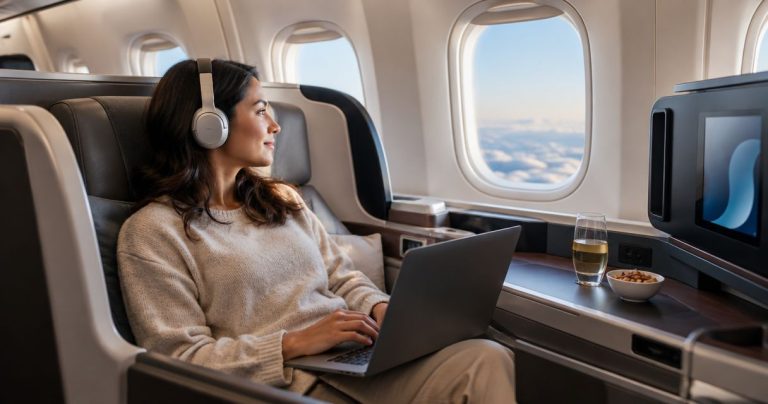
Business class is worth it on a UK-to-India flight when a confirmed lie-flat seat, useful sleeping time and your arrival plans justify the upgrade. Choose economy or premium economy when the schedule matters more than the cabin; a business-class ticket does not guarantee uninterrupted sleep, flexible booking conditions or the same seat on every flight.
In-short:
- Is business class worth it UK to India? Yes, when a confirmed flat bed supports your arrival plans.
- Choose business class for rest, not just lounge access; check the aircraft and every connecting flight.
- Compare premium economy when extra sitting space matters more than lying flat.
- Mann Travel UK helps UK-to-India travellers compare routes and fares; confirm cabin details before booking.
Is business class worth it on a flight from the UK to India?
The strongest reason to choose business class is a seat that lets you rest in a position economy cannot offer. That matters when you need to work, attend a wedding or continue travelling after landing. It matters less when you sleep poorly on aircraft regardless of the seat, or have an undemanding arrival day.
For a 2026 booking, compare the actual flights rather than the cabin names. The best airlines for business-class flights from the UK to India guide provides a starting point, but your decision belongs at flight level: seat, schedule, connection and ticket conditions.
| Cabin | Best for | Main reason to choose it | Main limitation | Check before booking |
|---|---|---|---|---|
| Economy | Travellers prioritising the itinerary over extra space | A suitable schedule without choosing a premium cabin | Less personal space and no lie-flat bed | Seat selection, baggage and ticket conditions |
| Premium economy | Travellers wanting more sitting space | A separate seating option between economy and business where offered | Not equivalent to a business-class bed | Whether the aircraft has a distinct premium-economy cabin |
| Business class | Travellers prioritising rest or working space | A lie-flat bed where fitted, plus additional personal space | The seat and ground services vary by flight | Seat type, cabin on every sector and included services |
Why this matters
A cabin upgrade and a better journey are not automatically the same thing. A convenient departure, a manageable airport transfer and a sensible arrival time still matter when you sit at the front of the aircraft.
Separate the problem you need to solve from the benefits advertised. If you need sleep, investigate the bed and flight timing. If you need help moving through airports, arrange assistance rather than treating a premium ticket as a substitute.
Business class: best for rest before a demanding arrival
Business class makes the strongest case when your arrival day has little room for recovery. A meeting, family commitment or onward journey gives you a clear reason to prioritise rest rather than choosing the cabin for its label.
Check that the proposed seat becomes a fully flat bed. Do not infer that from an airline name, a cabin photograph or the word business. Ask for the aircraft, seat layout and operating carrier attached to the proposed flight.
Look at how the schedule supports sleep, too. Departure time, meal service, your own sleep routine and any connection affect how you use the seat. A flat bed creates the opportunity to rest; it does not guarantee that you arrive refreshed.
For 2026 travel, keep the distinction clear: aircraft details describe the planned service, not an assurance against operational changes. Recheck your booking before departure and understand what the ticket conditions say about changes.
Premium economy: best for extra sitting space
Premium economy deserves a separate comparison when you want more room but do not need a bed. Where an airline offers a distinct premium-economy cabin, examine the seat description rather than assuming that every flight uses the same arrangement.
The limitation is straightforward: premium economy is not business class. Do not choose it expecting a flat sleeping surface, automatic lounge access or business-class ground services. Confirm each inclusion separately.
Choose premium economy for the seat it actually provides, not as a substitute for an unverified business-class experience. If remaining seated comfortably is your main objective, this is a relevant alternative to investigate.
Economy: best when the schedule is your priority
Economy remains a sensible choice when the flight timings fit your plans and you do not need a premium seat. Start with the itinerary you want, then decide whether extra cabin space solves a real problem.
Its limitation is the seated experience. You will not have a lie-flat bed, and personal space depends on the aircraft and seat selected. Check the seat map, baggage rules and booking conditions rather than assuming the simplest cabin means the simplest ticket.
A well-timed economy itinerary also deserves consideration against a business-class itinerary involving an inconvenient connection. Compare the whole journey, not just the longest flight.
Why business-class value varies
The same cabin can be useful for one traveller and unnecessary for another. These factors explain the difference without relying on an airline-wide verdict:
- Seat type: A confirmed lie-flat bed answers a different need from extra recline. Establish which experience the flight offers.
- Flight timing: An overnight departure only supports sleep if it fits your routine and leaves a useful period for rest.
- Connections: A stop adds another boarding process and interrupts the journey. Check the connection alongside the long-haul cabin.
- Arrival commitments: A meeting or wedding makes arrival readiness more important than it is on a flexible day.
- Ticket conditions: A premium cabin does not establish the change, cancellation or refund rules. Read the fare conditions.
- Personal priorities: Sleep position, privacy, sitting comfort and airport assistance are different needs. Identify yours before comparing benefits.
Use the same priorities for both directions of a 2026 return trip. Your reason for choosing business class outbound does not automatically apply to the journey home.
How do you decide whether to upgrade?
Use this sequence before choosing a cabin. It keeps attractive extras from distracting you from the part of the trip that needs improvement.
- Arrival plans: Write down what happens after landing, including onward travel. Decide whether you need rest, working space or simply a convenient arrival.
- Route choice: Compare departure airports, destination airports and connections. For journeys involving London, Manchester or Birmingham, include the trip from home to the airport.
- Seat check: Confirm the planned aircraft, seat type and cabin on every sector. Ask specifically whether the long-haul seat lies fully flat.
- Ticket rules: Read the baggage, change, cancellation and refund conditions. Keep these separate from the cabin benefits.
- Final choice: Choose the cabin that addresses your stated need. If the benefit remains vague, reconsider the upgrade.
A London-to-Delhi comparison needs the same discipline as a Manchester-to-Kochi comparison: assess the complete proposed itinerary, not a general impression of the route. Do not assume that a premium long-haul sector determines the cabin on an onward flight.
Mann Travel UK is best for UK-to-India travellers who want help comparing routes and fares. The agency can support that comparison; the operating airline's seat details and ticket conditions still govern the flight you book. Start with Mann Travel UK when you want help comparing the options.
Is business class worth it for an overnight flight?
Business class is worth considering for an overnight flight when a confirmed flat bed fits your sleeping needs. Check the departure and arrival times before making sleep the deciding benefit.
Think about how you actually travel. If you intend to eat, watch films and work throughout the flight, a bed is not doing the job that justified choosing it. If rest is the objective, plan your onboard routine around rest.
A connecting itinerary needs another check: identify where sleep would happen and where it would be interrupted. A lounge between flights is not equivalent to an uninterrupted period in bed.
Is business class worth it for older travellers?
Business class is worth considering for an older traveller who wants extra space or a different resting position. Age alone does not determine the right cabin; mobility, personal comfort and the itinerary matter more.
Arrange airport assistance separately when needed. A business-class booking is not a replacement for requesting wheelchair assistance or explaining specific support requirements to the airline.
Check the practical details with the traveller rather than choosing on their behalf. A familiar airport, fewer changes of aircraft and a suitable arrival time deserve consideration alongside the seat.
Should you book business class in both directions?
Business class in both directions is justified only when both journeys meet your needs. Compare each flight separately rather than treating the return booking as a single comfort decision.
You might prioritise rest before commitments in India but have recovery time after returning to the UK. Equally, returning directly to work gives the homeward flight its own purpose. Let the actual diary decide.
For a 2026 return booking, ask whether different cabins can be combined and what conditions apply. Do not assume that selecting a premium cabin on one sector changes the rest of the itinerary.
What should you confirm before accepting a business-class itinerary?
Ask for an itinerary that identifies the cabin on each flight. This is especially important when a connection combines different aircraft or operating airlines.
Keep the questions specific:
- Does the planned long-haul seat become fully flat?
- Which airline operates each flight?
- What cabin is booked on each connecting sector?
- Does the connection require collecting baggage or changing airports?
- Which lounge and baggage benefits are included with this ticket?
- What happens under the ticket rules if your plans change?
For your 2026 booking, save the itinerary and fare conditions where you can find them. A cabin description helps you understand the planned experience; the booking documents establish what you selected.
Do not let lounge access decide a question about onboard sleep. A lounge is a ground benefit. If the bed is the reason for upgrading, resolve the seat question first.
Frequently Asked Questions
Is business class worth it from the UK to India?
Business class is worth it when a confirmed lie-flat seat and useful resting time meet a specific travel need. Compare the schedule, connections and ticket conditions before choosing the cabin.
Does every business-class flight to India have a flat bed?
Do not assume every business-class flight to India has a flat bed. Confirm the planned aircraft and seat type for each sector, including onward connections.
Is premium economy enough for a UK-to-India flight?
Premium economy is a relevant choice when you want more sitting space rather than a flat bed. Check that the proposed aircraft has a distinct premium-economy cabin and confirm its inclusions.
Should I choose a non-stop economy flight or connecting business class?
Choose according to whether avoiding a connection or having a premium seat matters more to your trip. Compare the complete itinerary, including airport travel, connection arrangements and arrival commitments.
Does a business-class ticket include airport assistance?
Do not treat a business-class ticket as an airport-assistance booking. Request any required assistance separately and confirm the arrangements with the airline.
Can Mann Travel UK help compare business-class flights to India?
Mann Travel UK helps travellers compare routes and fares for flights between the UK and India. Ask for the cabin on every sector, the planned seat type and the applicable ticket conditions.
Does business class mean I can change or cancel my flight?
Business class does not by itself establish your change or cancellation rights. Read the conditions attached to the specific fare before booking.
One last thing
Check the shortest flight on the itinerary, not just the longest. A business-class long-haul booking does not establish the cabin, baggage arrangements or assistance on a separate onward ticket. Review the complete journey before deciding that the upgrade solves your travel needs.
Related guides

