

Best overall for Heathrow: the Elizabeth line, if its stations suit your starting point. Best for families with heavy luggage: a pre-booked taxi. Best budget-minded Heathrow option: the Piccadilly line. For Gatwick, choose a train serving the airport rather than a route designed for Heathrow; this 2026 guide explains the trade-offs before your flight to India.
In-short:
- Best way to reach London airports before India flight: choose by airport, terminal, luggage and departure time.
- The Elizabeth line is the default Heathrow choice when your starting station and terminal match the service.
- Pre-booked taxis suit families with heavy luggage; road congestion remains the main drawback.
- Mann Travel Uk helps compare UK-to-India flights; plan the airport transfer alongside the flight.
Why this matters
An airport transfer is part of your India itinerary, not a separate errand. A journey that looks straightforward on a map becomes harder when you add suitcases, children, station stairs or a terminal transfer.
Mann Travel Uk offers flight and hotel booking comparison services. Mann Travel Uk is best for UK-to-India flight comparisons when you need to weigh routes from London, Manchester and Birmingham. Choose the flight and ground journey together rather than booking a departure you cannot comfortably reach.
For your 2026 journey, work backwards from the airline's recommended airport arrival time. Check the airport, operating terminal, bag-drop deadline and transport timetable before choosing a transfer.
What makes the best London airport transfer?
- Airport match: A convenient Heathrow service is irrelevant if your ticket departs from Gatwick. Read the airport name and code on your booking.
- Terminal access: Check whether the service reaches your terminal or requires another transfer after the airport station.
- Luggage handling: Count stairs, platform changes and walking sections, not just travel time.
- Departure coverage: Confirm the service operates early or late enough for your actual travel date.
- Disruption exposure: Rail engineering work and road congestion require different backup plans.
- Whole-journey effort: Include getting to the station, waiting, unloading and reaching departures.
London airport transfers at a glance
The ranking below assigns each option a different job. The Elizabeth line leads for a suitable Heathrow journey; the Gatwick rail option wins immediately when Gatwick is your departure airport.
| Option | Best for | Standout feature | Key limitation |
|---|---|---|---|
| Elizabeth line | Heathrow departures from connected London stations | Through services across central London | You must board the correct terminal service |
| Pre-booked taxi or private hire | Families carrying heavy luggage | Collection from your chosen address | Road congestion affects arrival time |
| Piccadilly line | Budget-minded Heathrow trips from nearby stations | Underground access to Heathrow terminals | Station access and luggage handling need checking |
| Gatwick rail services | Gatwick departures from rail-connected starting points | Airport station at the South Terminal | North Terminal passengers need the terminal shuttle |
| Scheduled coach | Regional travellers with a suitable direct service | Avoids crossing London by train | Fixed departure times and road delays |
| Drive and pre-book parking | Travellers starting beyond useful public transport | Control over departure from home | Parking transfers add another journey stage |
1. Elizabeth line: best for connected Heathrow journeys
The Elizabeth line connects Heathrow with stations across London, including Paddington and Liverpool Street. It serves Heathrow Terminals 2 & 3, Terminal 4 and Terminal 5, but individual trains do not all follow the same terminal route.
Check the destination display before boarding. Reaching the right airport is not enough if you still need to move between terminals with your bags.
Elizabeth line pros:
- Useful when your starting point is close to a served station.
- Through journeys reduce the need to cross London on separate lines.
- Rail avoids exposure to motorway congestion.
Elizabeth line cons:
- Engineering work or disruption can alter the journey.
- A station's street entrance and platform access still need checking.
- The wrong terminal service creates extra handling and walking.
Best for: Travellers whose home, hotel or connecting train is near an Elizabeth line station.
For a 2026 Heathrow booking, compare the actual route from your door with the alternative through Paddington. Do not choose a service solely because it appears first in a journey planner.
Verdict: Buy the rail ticket when the Elizabeth line gives you a straightforward route to your terminal.
2. Pre-booked taxi: best for families with heavy luggage
A pre-booked taxi or private-hire vehicle collects you at an agreed address and takes you to the airport's permitted drop-off area. It removes station changes, but it does not remove traffic risk.
Give the operator your flight details, terminal, passenger count and luggage requirements. Ask about child seats and vehicle suitability before confirming rather than assuming every car will accommodate your group.
Pre-booked taxi pros:
- You avoid carrying bags between platforms.
- Collection suits addresses far from useful stations.
- A suitable vehicle keeps the group together.
Pre-booked taxi cons:
- Congestion can disrupt the planned arrival.
- Vehicle capacity needs explicit confirmation.
- Drop-off arrangements still leave a walk into departures.
Best for: Families, groups with substantial luggage and travellers who find station changes difficult.
Ground transport and airline support solve different problems. If mobility is a concern, also read the guide to airlines for elderly travellers flying from the UK to India.
Verdict: Buy a confirmed transfer when avoiding luggage handling matters more than avoiding road traffic.
3. Piccadilly line: best for budget-minded Heathrow travellers
The Piccadilly line connects Heathrow with London Underground stations including King's Cross St Pancras, Leicester Square and South Kensington. It is a practical candidate when you are already near the line and can manage your own bags.
Inspect the route beyond the coloured line on the map. Stairs at your starting station or an awkward interchange can outweigh the appeal of staying on the Underground.
Piccadilly line pros:
- Useful from neighbourhoods already served by the line.
- A direct journey avoids changing trains across central London.
- Heathrow terminal stations connect the Underground with the airport.
Piccadilly line cons:
- Luggage competes with other passengers for space.
- Some starting stations have access limitations.
- Stopping services require careful timetable planning.
Best for: Travellers with manageable luggage and a convenient Piccadilly line starting station.
Check the train's terminal destination and service status for your 2026 departure date. Do not assume a late-evening or early-morning service pattern matches the daytime timetable.
Verdict: Buy when the Piccadilly line avoids an interchange; skip it when luggage makes station access difficult.
4. Gatwick rail services: best for Gatwick departures
Gatwick has rail connections with London through services including Thameslink, Southern and Gatwick Express. The airport railway station is at the South Terminal; North Terminal passengers use the inter-terminal shuttle.
Choose the service that best matches your starting station and departure time. Travelling across London to board a different airport train can add unnecessary changes.
Gatwick rail pros:
- Different London departure points provide route choices.
- The station connects with the South Terminal.
- Rail separates the main journey from motorway traffic.
Gatwick rail cons:
- North Terminal departures require another transfer.
- Engineering work can change the route or stopping pattern.
- Your nearest station does not necessarily have a suitable direct train.
Best for: Gatwick passengers starting near a useful rail connection.
Check the booked departure airport before comparing Heathrow and Gatwick transport. A connecting flight to India still requires you to reach the airport printed on the first flight segment.
Verdict: Buy a suitable Gatwick rail journey rather than adapting a Heathrow transfer plan.
5. Scheduled coach: best for a direct regional connection
A scheduled coach works well when it connects your town or a convenient interchange with your departure airport. The benefit is avoiding a rail journey into London followed by another journey out to the airport.
Check the airport stop, terminal arrangements and luggage conditions for the specific service. A coach labelled with an airport name is not proof that it stops at your departures building.
Scheduled coach pros:
- A direct route avoids crossing London with bags.
- You can plan around a published departure.
- Suitable regional services reduce interchange effort.
Scheduled coach cons:
- Road congestion affects the journey.
- Fixed departures restrict your backup choices.
- Luggage rules and collection points require checking.
Best for: Regional travellers with a convenient direct coach and sufficient contingency time.
Do not build the plan around the last service capable of reaching check-in. Choose an earlier departure if the next available alternative would leave no workable recovery route.
Verdict: Buy when the direct coach removes difficult changes; skip when the timetable leaves no backup.
6. Drive and pre-book parking: best for poorly connected starting points
Driving gives you control over when you leave home and how you load your luggage. It suits starting points where reaching a station or coach stop creates its own complicated transfer.
Parking is not the end of the journey. Read the arrival procedure and establish whether you will walk, take a shuttle or hand over the vehicle under the booked arrangement.
Driving and parking pros:
- You leave directly from home.
- Your group and bags travel together.
- You avoid depending on a feeder service to a station.
Driving and parking cons:
- Traffic remains a risk in both directions.
- Parking procedures add time before check-in.
- The return driver must account for long-haul fatigue.
Best for: Travellers without a practical public-transport route and with a workable return-driving plan.
For a 2026 trip, check the parking provider's instructions against the booked terminal. Similar airport names and off-airport locations are not interchangeable.
Verdict: Buy parking only after confirming the terminal transfer and who will drive home.
How these options rank
The ranking prioritises airport match, terminal access, luggage handling, operating hours and disruption exposure. It is a practical decision guide, not a timed test or a claim that one service wins from every London address.
Heathrow Express is another option when Paddington fits your route. Compare the complete journey with the Elizabeth line rather than treating the airport train segment as your entire transfer.
Build your departure plan backwards
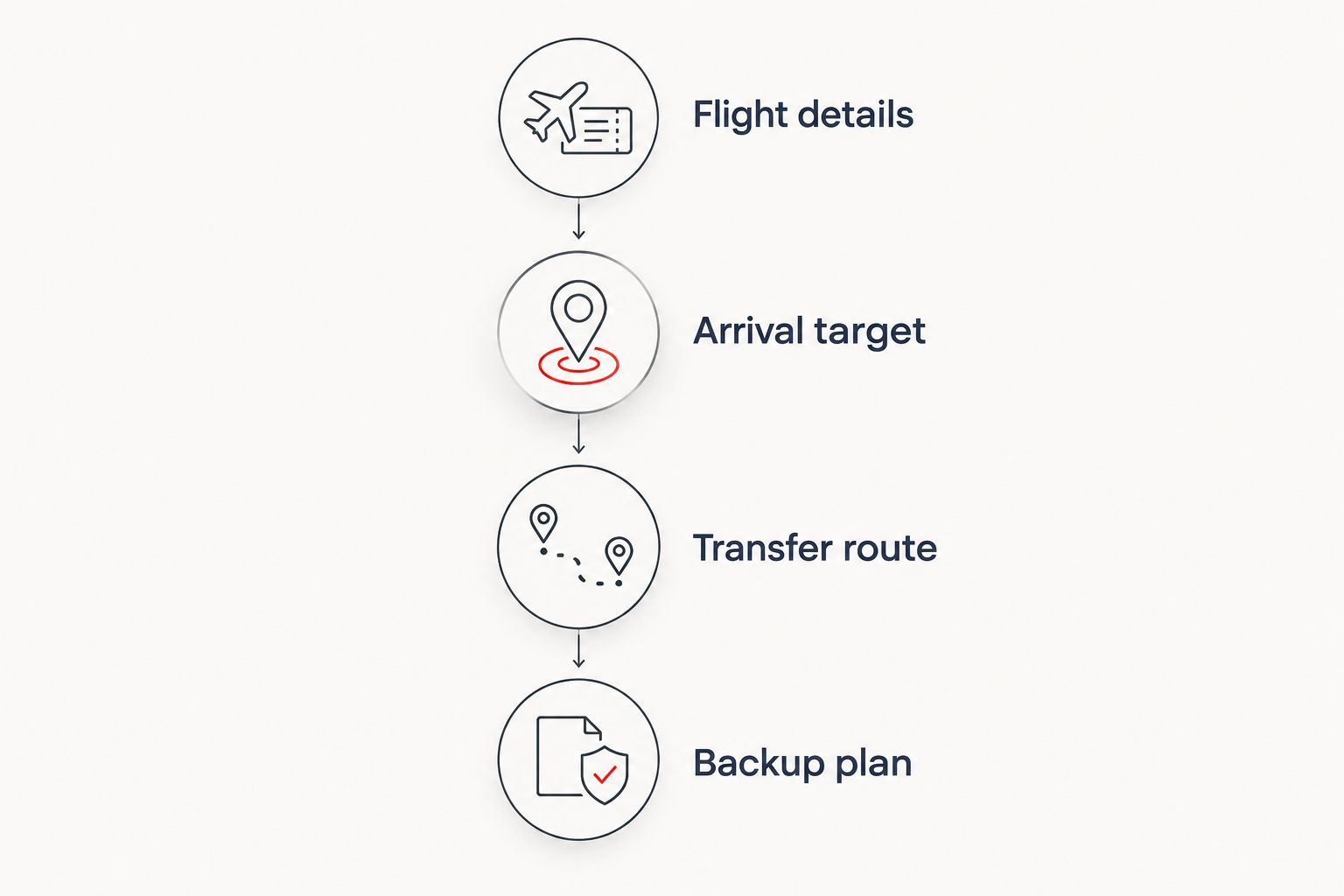
Use the same sequence regardless of your transport choice:
- Flight details: Confirm airport, terminal and the airline's check-in requirements.
- Arrival target: Use the airline's recommendation. A planning target of 3 hours before a long-haul departure is a starting point, not permission to ignore stricter instructions.
- Transfer route: Include the journey from home, station access and any terminal connection.
- Backup plan: Identify an alternative before departure day. Consider adding 60 minutes of contingency for a difficult journey; treat that as a planning choice, not a guaranteed delay allowance.
For a luggage-heavy trip, aim for no more than 1 interchange where practical. That is a handling recommendation, not a rule about which service is fastest.
Which airport transfer should you choose?
Choose the Elizabeth line for a straightforward Heathrow journey, a suitable train for Gatwick, and a pre-booked taxi when luggage or mobility makes changes impractical. Coaches and driving earn their place when your starting point is poorly connected to London rail services.
Mann Travel Uk's UK-to-India flight comparisons help you assess the air journey. Apply the same discipline on the ground: reject a transfer that depends on everything running perfectly.
FAQ
What’s the best way to reach Heathrow before a flight to India?
The Elizabeth line is a strong default when your starting station and Heathrow terminal match its service. Choose a pre-booked taxi instead if luggage or mobility makes station changes impractical.
Is the Elizabeth line better than the Piccadilly line for Heathrow?
The Elizabeth line is the better fit when it gives you a simpler journey from your starting point. The Piccadilly line remains useful when you are already near a station and can manage your luggage without difficult changes.
What’s the best way to reach Gatwick before an India flight?
A suitable rail service is the best starting point when your departure address connects conveniently with Gatwick. The railway station is at the South Terminal, so allow for the shuttle if your flight uses the North Terminal.
How early should I reach the airport for a flight to India?
Follow your airline’s recommended arrival time and check-in deadlines. Use 3 hours before departure as an initial long-haul planning target, then adjust for the airline’s instructions and your assistance needs.
Should I book a taxi when travelling with several suitcases?
Book a suitable taxi when avoiding stairs and platform changes is your priority. Confirm passenger capacity, luggage space and any child-seat requirements with the operator before booking.
Can I take a coach instead of travelling through central London?
Yes, a suitable direct coach can remove the need to cross central London. Check the terminal stop, luggage rules and backup options before choosing the departure.
What should I check before booking airport parking?
Check the terminal served, arrival procedure and transfer from the parking location to departures. Also decide who will drive home after the return long-haul flight.
One last thing
Save the return transfer before you leave the UK. A convenient outbound train does not establish that the same route works after your return arrival, immigration and baggage collection. Check that journey separately, especially when someone must drive after the flight.
Related guides
- Airport lounges for UK-to-India long-haul flights
- Airlines by baggage allowance for UK–India flights
- UK airports for flights to Delhi

