
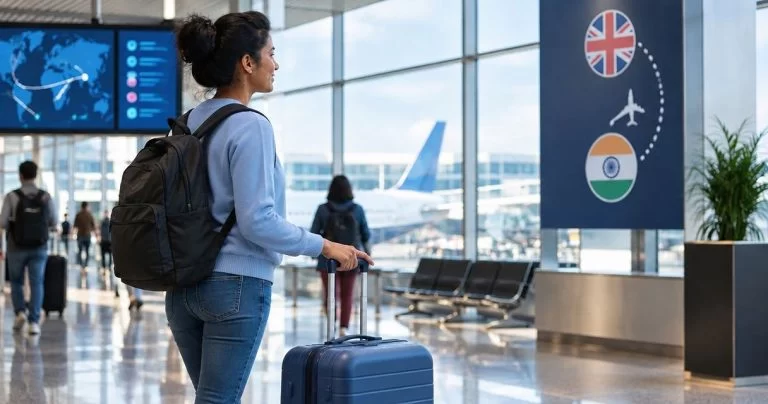
Instead of guessing whether to collect your checked baggage during a UK–India layover, confirm the transfer arrangement before departure and check the destination printed on your bag tag. This 2026 guide explains how to handle through-checked bags, customs collection and self-transfers without following the wrong airport route.
In-short:
- Checked baggage layover UK India flight planning starts with your ticket arrangement, bag tag and customs instructions.
- A final-destination bag tag does not remove a customs collection requirement.
- For separate tickets, plan to collect and recheck baggage unless the airlines explicitly confirm another arrangement.
- Mann Travel UK suits UK–India travellers who want agency help comparing flight routes before booking.
Why this matters
Your connection has two separate parts: getting yourself to the next departure gate and getting your suitcase onto the next aircraft. A boarding pass for the onward flight does not prove that your bag will transfer automatically.
Check the baggage journey, not just the passenger itinerary. Whether collection is necessary depends on the ticket arrangement, airline agreements, airport process and customs requirements. A shared booking reference alone does not settle every question.
Mann Travel UK offers UK–India flight comparison services. When comparing connecting itineraries, ask about baggage handling alongside the departure airport and arrival time; the operating airline must confirm the arrangement for your actual journey.
Before you start
- Gather your documents. Keep your complete itinerary, ticket details, operating-airline names and any written baggage-transfer instructions together. Include the return journey, which needs its own check.
- Check entry requirements. Establish whether collecting baggage requires entry into the transit country. Permission to remain airside is not the same as permission to pass immigration and use landside check-in.
- Expect the customs exception. A bag tagged to your final destination can still require collection for customs, particularly when an international arrival connects to a domestic flight in India. Confirm the exact airport procedure before departure.
For a 2026 trip, use instructions that apply to your travel date and operating flights. A previous journey through the same airport is not confirmation that the current transfer works identically.
Ticket and transfer arrangement
Identify the baggage handover
- Read the complete itinerary. Identify every flight sector, operating airline, arrival airport and departure airport. An airport change means your bag cannot simply follow you through an airside connection.
- Establish the ticket arrangement. Ask whether the flights form a through-ticketed journey or are separate tickets. Do not treat flights displayed together in a search result as proof of through-checking.
- Ask one precise question. Use: Will my checked bag be accepted through to my final airport, and where must I physically collect it?
- Record the answer. Save written airline instructions where provided. Check again at departure, because the bag accepted at the counter must match the arrangement you planned.
Expected result: you can name the airport where you next take possession of your suitcase, rather than assuming it is your final destination.
Compare the transfer types
Use the table below to distinguish baggage handling from connection convenience. These are planning categories, not promises about an individual ticket.
| Arrangement | Best for | Advantage | Limitation and required action |
|---|---|---|---|
| Through-checking without collection | Travellers prioritising fewer baggage handovers | No baggage reclaim during that connection | Requires airline acceptance and a transfer process that permits it; verify the bag tag |
| Through-tagging with customs collection | Travellers connecting internationally to a domestic flight where collection is required | The bag can already carry the final destination | You still collect it, clear customs and follow the designated baggage handover process |
| Separate-ticket self-transfer | Travellers accepting responsibility for the connection | Lets you combine independently booked flights | Plan for collection, entry formalities, check-in and security; check each ticket's conditions |
A through-ticketed journey reduces some planning complexity, but it is not a universal instruction to walk past baggage reclaim. Equally, separate tickets do not prove that through-checking is impossible; they mean you must not rely on it without explicit airline confirmation.
Departure check-in and baggage receipt
Check the tag before your bag leaves
- Present the entire journey. Show the check-in agent your onward flight details, including any separately booked sector. Do this before the agent finishes accepting your baggage.
- Ask where to collect. Confirm whether your suitcase transfers automatically, needs customs collection or must be checked in again. Ask about each connection if your itinerary has more than one.
- Read the destination code. Check the final airport printed on the baggage tag. For example, DEL identifies Delhi, BOM identifies Mumbai and ATQ identifies Amritsar; the printed destination must match the arrangement the agent describes.
- Keep the baggage receipt. Retain the identification receipt for every checked bag. Photograph the receipts and your suitcase so you can describe and identify the baggage if it is delayed.
- Resolve discrepancies immediately. If the tag ends at the layover airport but you expected through-checking, ask the agent to explain before you leave the counter.
Expected result: you hold a baggage receipt and understand both the tagged destination and any collection point before it.
For your 2026 departure, use 2 separate checks at the counter: where the bag is tagged, and where you must collect it. These questions address different things, so ask both even when the first answer sounds reassuring.
Keep allowances separate from transfer rules
Baggage allowance tells you what your ticket permits you to check in. Baggage transfer tells you what happens to those bags between flights. One does not answer the other.
Review the allowance for every sector, especially when an international flight connects to a domestic ticket booked separately. Do not assume the onward booking accepts the same number or weight of bags.
The guide to baggage allowances on UK–India flights provides a separate starting point for that comparison. Confirm your own ticket's allowance before packing; route-level comparisons do not replace the conditions attached to your booking.
Layover route and baggage handover
Follow the confirmed airport process
- Read the arrival signs before committing to a route. Distinguish flight connections from arrivals and baggage reclaim. If the signs conflict with your instructions, speak to transfer staff before passing an immigration or security checkpoint.
- Stay on the transfer route only when appropriate. For confirmed airside baggage transfer without collection, follow the airport's connection process and complete any required transit security checks.
- Collect baggage when instructed. If customs or self-transfer procedures require collection, follow the arrivals process. Keep your passport, entry permission and onward itinerary accessible.
- Use the correct handover point. After customs, some journeys use a designated transfer-baggage counter; others require ordinary airline check-in. Follow the instructions for your airport and operating airline, not an assumed universal process.
- Complete the onward departure process. Check the next flight's terminal, security route and boarding information. A baggage handover is not the same as reaching the gate.
Expected result: your bag is either confirmed as remaining in the transfer system or has been handed back through the correct onward process.
Never use a generic layover duration as proof that a self-transfer is workable. Baggage delivery, immigration, terminal movement and the onward check-in deadline all sit between the flights. For 2026 travel, obtain the actual deadlines for your operating flight and airport.
Keep 3 questions ready for airport staff: Where do I collect? Where do I hand the bag back? Which departure area do I use afterwards? Those answers are more useful than a general assurance that the connection is straightforward.
Variant: connecting to a domestic flight in India
An international arrival followed by a domestic Indian flight needs an explicit customs check in your plan. Do not assume a final-destination tag means you can proceed directly to the domestic gate.
For example, a UK–Delhi–Amritsar itinerary reaches India at Delhi before continuing domestically. Ask the operating airline whether you must collect your suitcase at Delhi, take it through customs and then deliver it to an onward transfer counter or check-in desk. Treat the answer as itinerary-specific.
Use this sequence:
- Confirm the baggage and customs process before leaving the UK.
- Check the bag tag and collection instructions at UK departure.
- Follow immigration, collection and customs instructions at the Indian arrival airport.
- Complete the specified baggage handover and domestic departure checks.
Expected result: you know whether Delhi is a baggage collection point even when Amritsar appears on the tag.
A terminal change adds another task; an airport change adds a landside journey. Check the airport names and codes, not just the city name. Do not leave customs-controlled baggage behind because an onward boarding pass is already on your phone.
Troubleshooting
The bag tag ends at the layover airport
Ask the departure agent whether this is intentional. The airline might require collection or might not accept the bag through to the onward flight. Get a clear instruction before leaving check-in, then plan the collection and recheck route accordingly.
You have separate tickets but expected an automatic transfer
Plan to retrieve and recheck the bag unless the airlines explicitly confirm through-checking. Check entry permission, onward check-in deadlines and baggage conditions before travel. If the transfer cannot be completed under those requirements, change the itinerary rather than relying on airport discretion.
Your bag does not appear at the required collection point
Report it to the airline's baggage-service desk or appointed handling agent before leaving the baggage area. Show the baggage receipt and onward itinerary. Ask how to continue to your next flight and how the airline will record your delivery address and contact details; retain the report reference.
Your inbound flight is delayed
Contact the airline's transfer or service desk and explain both the passenger connection and baggage arrangement. For separate tickets, contact the onward airline as well; do not assume the first carrier will amend an unrelated booking. If rebooked, ask where the bag will travel before leaving the desk.
Your itinerary changes after check-in
Ask staff to confirm the bag's destination after a cancellation, rerouting or missed connection. Do not assume it follows the updated boarding pass automatically. Keep the original baggage receipt until the suitcase is back with you.
Customise your workflow
Build a short baggage note for each direction of your 2026 journey. Record the operating flights, collection airport, handover point and the source of the instructions. Keep it accessible offline alongside your itinerary.
If you travel with family, retain 1 baggage receipt per checked bag and make sure the travelling group knows who holds them. Keep passports, essential medication and necessary travel documents accessible rather than placing them in a suitcase that might transfer separately.
Mann Travel UK helps compare UK–India flight routes; the operating airline confirms baggage acceptance and transfer handling. Choose the itinerary only after the baggage process fits your entry permissions and connection requirements. That check matters more than selecting a route solely because its total journey looks shorter.
Frequently Asked Questions
Do I need to collect checked baggage during a UK–India layover?
Collect your checked baggage if the airline or airport procedure requires it for customs, self-transfer or another handover. If through-checking without collection is confirmed, follow the transfer route instead. Verify both the bag tag and the collection instructions at departure.
Does a bag tagged to my final destination transfer automatically?
A final-destination tag does not guarantee that you can skip baggage collection. Customs procedures can require you to collect and present the bag before handing it back for the onward flight.
Can my baggage transfer between separate tickets?
Do not rely on baggage transfer between separate tickets without explicit airline confirmation. Otherwise, plan to collect and recheck the bag, including any entry formalities and onward check-in requirements.
Do I collect my suitcase in Delhi before a domestic connection?
Confirm the collection and customs procedure for your exact Delhi connection with the operating airline. An international-to-domestic journey can require baggage collection even when the tag shows your final Indian airport.
Is a short layover enough when I must recheck baggage?
A short layover is not proof that a baggage self-transfer is workable. Check immigration, collection, terminal travel, security and the onward airline’s check-in deadline before booking.
What happens to my bag if I miss the connecting flight?
Ask the airline to confirm your bag’s location and destination when the connection changes. Keep your baggage receipt and obtain instructions for collection or onward handling rather than assuming the suitcase follows your new boarding pass.
Can Mann Travel UK help me compare connecting flights to India?
Mann Travel UK offers flight comparison services for UK–India journeys. Include baggage-transfer questions when comparing routes, and obtain confirmation of the handling arrangement from the operating airline.
One last thing
A baggage tag is a routing label, not an instruction to skip customs. Before your 2026 departure, save the baggage receipts and write down the airport where you must next physically collect your suitcase. That single distinction prevents the central mistake in connecting-baggage planning.

