

Choose Mann Travel UK if you want a travel agency to compare UK–India routes and fares; choose Air India directly if you have already selected an Air India itinerary and want to book with the airline. In 2026, the decision is about who helps you choose and manage the booking—not which name guarantees a better flight.
In-short:
- Mann Travel vs Air India compares an agency booking route with booking directly through an airline.
- Mann Travel UK is best for travellers comparing UK–India flights across routes and fares.
- Air India direct is best for travellers who have already chosen an Air India itinerary.
- Compare the same flights, cabin, baggage and fare rules before choosing your booking channel.
Why this matters
A travel agency and an airline do different jobs. Mann Travel UK helps travellers compare flights; Air India operates flights and sells airline tickets directly. Booking through an agency does not turn the agency into the operating carrier.
That distinction matters when you compare a London–Delhi journey with alternatives from Manchester or Birmingham. First decide which itinerary suits your trip. Then decide which booking channel suits the help you need.
An agency-versus-airline comparison is a booking decision, not an onboard-quality ranking. For your 2026 trip, keep route selection, ticket conditions and booking responsibility separate.
At a glance
| Dimension | Mann Travel UK | Air India direct |
|---|---|---|
| Best for | Travellers still comparing routes and fares | Travellers who have selected an Air India itinerary |
| Search scope | Agency comparison of flight options | Airline-direct search centred on Air India itineraries |
| Departure planning | Comparing London, Manchester and Birmingham options | Checking a selected itinerary through the airline |
| Standout feature | Help comparing UK–India journeys | Booking with the airline rather than an agency |
| Booking responsibility | An agency is part of the booking relationship | The airline is the direct booking counterparty |
| Onboard experience | Determined by the booked flight and operating carrier | Determined by the booked flight and operating carrier |
| Fare conditions | Check the specific ticket and booking terms | Check the specific ticket and booking terms |
| Pricing model | Compare the ticket total and any agency charges | Compare the ticket total and any airline extras |
An agency suits comparison; Air India direct suits a settled choice
Mann Travel UK is best for UK–India travellers who want help comparing routes and fares. Its stated service covers travellers visiting family, attending weddings and travelling for business. Those trips can start with a destination and a deadline rather than a preferred airline.
Suppose you need to reach Amritsar for a family event but have not settled on your departure airport. An agency comparison fits that question better than starting with a commitment to one airline. Ask for alternatives against the same arrival deadline and baggage needs.
Air India direct fits a different profile: you know the flight you want and are ready to examine its ticket conditions. The limitation is scope. Selecting an airline first does not answer whether another carrier or departure airport better suits the journey.
Neither approach removes your responsibility to read the itinerary. A convenient departure time can still produce an unsuitable arrival or onward connection.
Agency comparison wins when your airline is still undecided
A travel agency's useful role is comparing alternatives before you commit. The client's stated service includes flights to India, hotel bookings and flights to other international destinations. That gives you a reason to ask about the journey rather than only one airline's timetable.
For UK–India travel, frame the request around what cannot change:
- The destination you need to reach.
- The latest acceptable arrival date and time.
- The departure airports you can realistically use.
- Whether you require a nonstop journey.
- Your baggage and cabin requirements.
Air India direct is the better fit once that comparison has produced an Air India preference. You can focus on the selected itinerary instead of continuing a broader search.
The trade-off is straightforward: broader comparison helps you choose; airline-direct booking keeps the purchase centred on the airline you have chosen. Neither establishes a lower total by itself.
Agency comparison is more useful when departure airports are flexible
The agency's stated UK departure coverage includes London, Manchester and Birmingham: 3 departure cities to consider, not a promise that every route operates from each one. Its named Indian destinations include Delhi, Mumbai, Amritsar, Chennai, Hyderabad, Bangalore, Kochi and Goa: 8 destination cities around which to build a request.
For a 2026 wedding trip, compare the complete journey from home to your final destination. A different departure airport changes the ground journey as well as the flight. Include rail travel, airport transfers and any overnight stay in your decision.
Air India direct suits you when your chosen departure point and airline itinerary are already fixed. Check the current search results for your dates rather than assuming that a previously advertised route still matches your plans.
Do not treat destination coverage as evidence of nonstop service. Ask whether each proposed itinerary includes a connection and identify the operating carrier on every flight segment.
Air India direct wins when you want an airline-direct purchase
Air India direct is the clearer choice if your requirement is to buy from the airline rather than through an agency. That is a difference in booking structure, not a claim about faster refunds or better customer service.
An agency booking adds an agency to the relationship. Before paying, establish who issues the ticket, who receives change requests and who handles a cancellation request. Keep the written answers with your confirmation.
Direct booking removes the agency from that purchase relationship. It does not remove ticket restrictions, connection risks or the need to check passenger details.
The agency remains useful when you want help selecting between journeys. Its limitation is that you must understand how its booking responsibilities interact with the airline's responsibilities. Do not assume that every later request can be handled through either party interchangeably.
Air India direct simplifies the booking-party question
When you buy directly from an airline, the answer to who sold you the ticket is straightforward. When you buy through an agency, you need to distinguish the booking seller from the airline operating the flight.
That makes direct booking a practical preference for a traveller who wants an airline-direct purchase and has already done the comparison. It does not prove that a particular change will be free, immediate or permitted.
Before an agency booking, ask:
- Who should receive a voluntary date-change request?
- Who communicates a schedule change?
- Where should you submit a refund request?
- Are any seller charges separate from airline charges?
Use the answers to decide whether the booking arrangement suits you. No channel wins on service speed without evidence about the specific service being compared.
Both channels lead to the flight you actually book
For the same flight, date and cabin, the booking channel is not a separate onboard product. Compare the operating airline, cabin and itinerary—not the agency name against the airline name as though both operate aircraft.
An agency booking does not, by itself, establish better seating, meals or baggage. A direct booking does not, by itself, establish those advantages either. Check the details attached to the ticket you are considering.
This is an honest tie. If onboard comfort is your main concern, settle the airline and cabin question first. Choose the seller after confirming that both offers describe the same journey.
For connecting itineraries, inspect each segment. A carrier's name at the top of a search result is not a substitute for checking the operating carrier shown for each flight.
Both require you to read the fare conditions
Neither an agency nor an airline-direct booking makes a restrictive fare flexible. Your comparison must include the rules attached to the ticket and any separate terms attached to the booking service.
Check cancellation conditions, permitted changes, baggage and the passenger-name requirements before payment. Do not infer refundability from a cabin label or from the fact that a person helped arrange the booking.
Keep 2 booking layers separate: the airline ticket conditions and the seller's booking conditions. They answer different questions, even when the seller is also the airline.
This dimension is another tie. The winning offer is the one whose written conditions fit your needs—not the one whose booking channel sounds more reassuring.
Pricing: compare totals, not agency-versus-airline assumptions
For a 2026 comparison, neither booking channel is automatically the cheaper choice. Compare the same itinerary at the point you are ready to purchase, including the baggage and other selections you need.
The agency model combines ticket booking with an intermediary relationship. Ask whether the quoted total includes all applicable charges and whether later booking services carry separate charges. Do not assume that a separate agency charge exists—or that none applies.
The airline-direct model is a purchase from the airline. Inspect the selected fare and any extras before comparing its total with an agency quote. A headline fare and a fully specified itinerary are not equivalent offers.
Predictability comes from knowing the payable total and the change conditions. Flexibility comes from the actual ticket rules and service terms, not from choosing an agency or airline label.
Compare the booking in this order
Use this sequence before paying. It prevents a comparison between different flights, different baggage allowances or different responsibilities from looking like a simple difference between sellers.
- Match flights: align travel dates, airports, flight numbers, connections and cabin.
- Match baggage: check the allowance stated for each proposed ticket.
- Read conditions: review changes, cancellations and passenger details.
- Confirm responsibility: establish who handles later booking requests.
- Compare totals: compare the completed offers, including required extras.
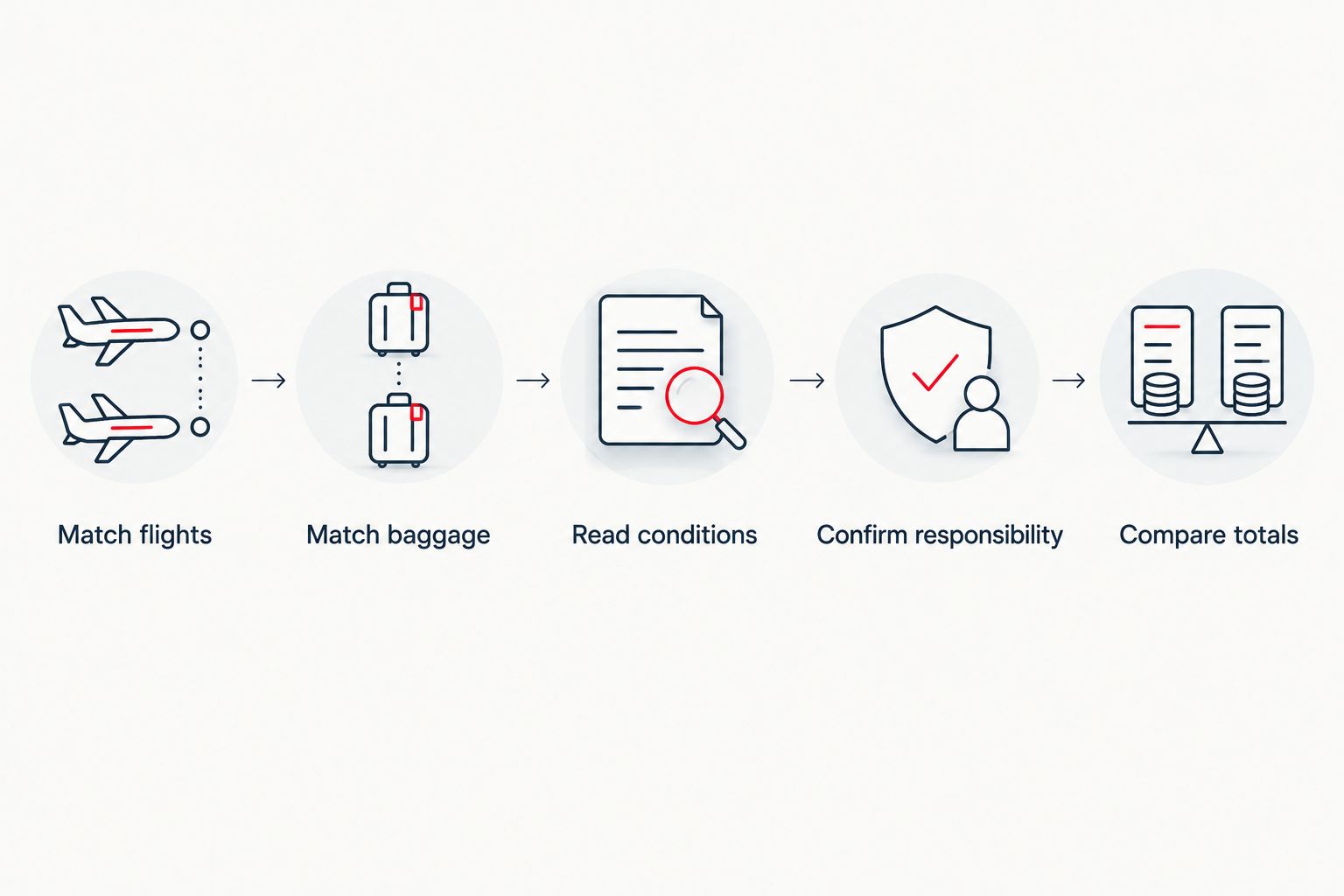
A useful comparison ends with written details you can review. If an offer leaves the operating carrier, baggage or change conditions unclear, resolve that uncertainty before choosing the seller.
Compare your UK–India journey
Ask about routes and fares from London, Manchester or Birmingham to your Indian destination.
Final verdict for 2026
Choose Mann Travel UK if you are a route-flexible family traveller
You know where you need to arrive but want help comparing departure cities, routes and fares. The agency model fits that selection problem. Confirm the final itinerary and booking responsibilities before purchase.
Choose Air India direct if you are an airline-decided traveller
You have selected an Air India journey, understand its conditions and want to purchase directly from the airline. Direct booking fits that preference without requiring another round of agency comparison.
| Dimension | Winner |
|---|---|
| Best for | Agency for undecided travellers; Air India direct for airline-decided travellers |
| Search scope | Agency for comparing alternatives |
| Departure planning | Agency when UK departure cities are flexible |
| Standout feature | Air India direct for an airline-direct purchase |
| Booking responsibility | Air India direct for a simpler seller relationship |
| Onboard experience | Tie when comparing the same flight and cabin |
| Fare conditions | Tie; inspect the specific terms |
| Pricing model | No automatic winner; compare completed totals |
FAQ
Is Mann Travel UK an airline or a travel agency?
Mann Travel UK is a travel agency offering flight and hotel booking comparison services. It helps travellers compare UK–India routes and fares; it is not the operating airline.
Is booking directly with Air India better than using an agency?
Air India direct is better suited to travellers who have selected an Air India itinerary and want an airline-direct purchase. An agency is better suited to travellers who still want help comparing routes and fares.
Is an agency always cheaper than booking Air India directly?
Neither channel is automatically cheaper. Compare the same flights, cabin, baggage and ticket conditions using the completed payable totals.
Will booking through an agency change my onboard experience?
The booking channel does not create a different onboard product for the same flight and cabin. Check the operating carrier and the details of the ticket you select.
Who handles changes when I book through a travel agency?
Confirm the change-request process with the agency before paying. Establish who handles the request and distinguish airline ticket conditions from any separate seller terms.
Can I compare departures from London, Manchester and Birmingham?
Yes, those departure cities are included in the agency’s stated UK–India comparison service. Ask for itineraries that match your dates and destination; city coverage does not establish nonstop service on every route.
What should I check before booking a UK–India flight in 2026?
Check the itinerary, operating carriers, baggage, fare conditions, booking responsibilities and completed total. Compare equivalent offers before choosing between an agency and an airline-direct booking.
One last thing
Save the comparison, not just the confirmation. Keep the itinerary, baggage details, conditions and seller's answers together before payment. A booking reference alone does not explain why one offer suited your trip better than another.
Related guides
- Best UK airports for flights to Delhi
- Airlines compared by baggage allowance for UK–India flights
- Domestic connecting flights within India for UK arrivals

